
These are the HR trends for 2026
Sustainable employability is the number one spot and work happiness will become less important for organizations in 2026. Those are the key findings of the annual Trends in HR survey. What HR sees at the organizational level and what HR employees themselves think is largely in the same direction, but HR employees place slightly more emphasis on their own well-being, job happiness and development, while HR looks more broadly at organizational perspectives such as recruitment and strategic planning.

In November 2025, Trends in HR conducted research on the most important and future HR trends. The survey was completed by 228 HR professionals in the Netherlands. In a labor market that remains tight, attracting and retaining talent is the most important challenge for HR for the next 3 to 5 years. This article provides an overview of HR trends and themes for 2026.
Top 5 current HR themes for 2026
For HR at the organizational level:
- Sustainable Employability (10.5%)
- Training & Development (10.2%)
- Absence (9.3%)
- Recruitment & Selection (8.9%)
- Leadership (8.4%)
- Strategic Workforce Planning (8.4%)
- Job Happiness (7,8%)
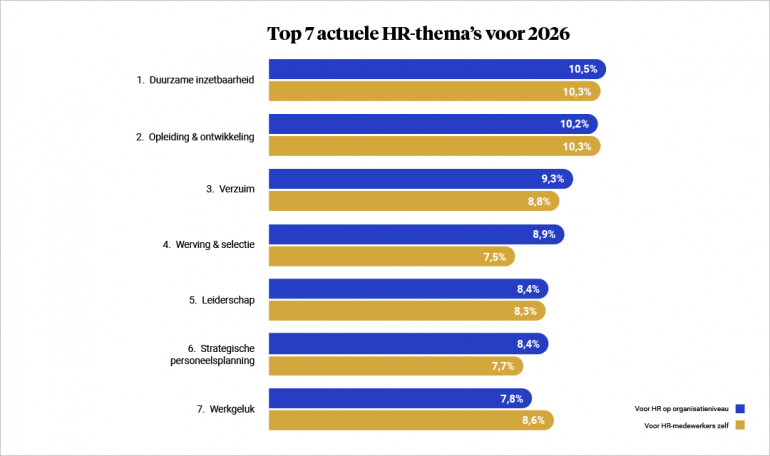
The themes that HR sees at the organizational level versus what HR employees themselves would choose as the most important themes contain many similarities, but also some differences in emphasis. The difference in order and nuance is in the top 2. For HR, sustainable employability (10.5 percent) is just at the top. Individually, training & development and sustainable employability (both 10.3 percent) are seen as equally important. This suggests that employees and HR value the same themes, but that employees value personal growth slightly more equally than organization-wide employability.
1. Sustainable employability top priority
Both from HR and individual perspectives, sustainable employability is given top priority. This confirms a broad-based focus on investing in employees, development and future-proofing talent. Especially adapting the work situation to the employee and preventing unwanted turnover are core themes. This theme is growing in importance and is receiving more strategic focus than in previous years.
Read also:This is the role of basic psychological needs in sustainable employability?
Why employees leave: shift in motivations
The survey shows that the reasons for employee turnover are changing. Whereas in 2024 inadequate pay and recognition (31.7 percent) and limited advancement opportunities (30.2 percent) topped the list, we see a clear shift in 2026. Limited advancement opportunities remain the most important reason (33.5 percent), but a mismatch with the organizational culture (22.3 percent) is gaining ground. Interestingly, insufficient pay or recognition drops to 16.5 percent, and work-life balance also declines further to 9 percent.
The focus is shifting from financial appreciation to development opportunities and an appropriate organizational culture.
2. Training & development
Training and development are high on the agenda of organizations and HR departments and are increasingly seen as a strategic means to remain agile.
The research by Trends in HR makes it clear that learning is no longer just about a separate training or course, but is closely linked to mobility, retraining and retraining, as well as to broader themes such as sustainable employability, talent management and binding and engaging employees.
Organizations see a constant need to strengthen professional knowledge, while at the same time personal growth and soft skills - such as critical thinking and adaptability - are becoming more important. In practice, however, they run up against lack of time on the part of employees, limited financial resources and sometimes insufficient commitment from managers. At the same time, digital and technological developments, including AI, call for new forms of learning, which increasingly combine formal learning, digital learning opportunities and coaching or mentoring.
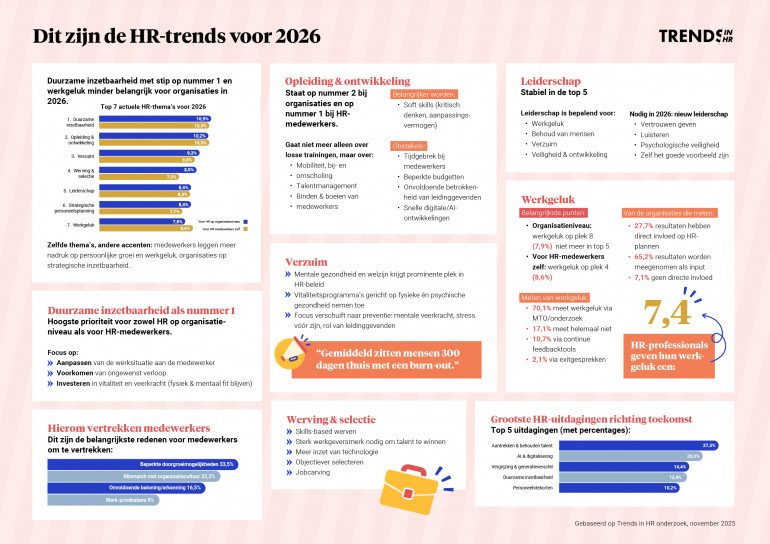
Click on the image to enlarge it.
3. Absenteeism
Mental health and wellness is taking a more prominent place, with a significant increase in focus on mental health and wellness programs to reduce absenteeism and promote job happiness.
Organizations are increasingly betting on vitality programs that support both physical and mental health. Increasing mental resilience is seen as a preventive tool to prevent stress and burnout before absenteeism occurs. Through training, coaching and engaged managers, efforts are being made to strengthen the resilience of employees.
This is necessary, too. On average, people spend 300 days at home with a burnout. A little stress is part of life and even healthy. But when does stress become too much? According to psychiatrist and stress researcher Christiaan Vinkers, we need to intervene much earlier. Before failure occurs. And above all: approach the concept of burnout differently.
"We should not see burnout as a diagnosis, but as a signal," he says. That's why he advocates a different approach: not to focus on burnout, but rather on the road towards it. Because the real problem starts much earlier. And that is exactly where HR has the opportunity to make a difference. Recruitment & selection
Recruitment & selection is present as a topical HR topic in 2026 and is on the priority list of many organizations. Organizations in 2026 will focus primarily on:
- Skills-based recruiting where the focus is less on diplomas and work experience and more on skills and potential of candidates.
- Strengthening the employer brand (employer branding) to attract talent in a tight labor market.
- The use of technology, recruitment automation and data analytics to optimize the recruitment and selection process.
- Objective and structured selection processes, for example, with standardized interview questions and reducing bias through anonymous applications.
- Innovative methods such as job carving, in which the task package is adapted to the candidate's strengths.
5. Leadership steady high
Both groups place leadership in the top 5. So it is an important theme for HR, as it is the driver of almost all HR goals: job happiness, retention, absenteeism, safety and development. In a time of tightness, hybrid working and high workloads, what is especially needed is new leadership: leaders who give trust, listen, build safe teams and lead by example themselves. HR is the logical director to initiate that movement. Before 2025, a third already indicated that new ways of leadership will be needed in the future.
Leon Schaepkens, psychologist and public administration lawyer calls on HR to step out of its executive roles and take on a new role as an interpreter, procrastinator, confronter and booster of psychological safety. "HR is the party with the courage to name what chafes and help leaders create psychological safety." He says it is not the time to wait and see if management is "open to change. "If HR doesn't take this role, no one will. We don't need to shout revolution, we need to light the campfire."
Read also: The best leaders dare to slow down
6. Strategic workforce planning
Continuing labor market tightness and an aging workforce make strategic workforce planning indispensable for organizations that want to remain future-proof. First, strategic planning helps prevent knowledge loss due to aging, allowing organizations to retain expertise and business-critical knowledge. Second, it provides advancement opportunities, which is relevant given that the lack thereof is the leading reason for employee turnover at 33.5 percent. Third, it increases flexibility in roles and employability of employees. And that, in turn, is especially important in a rapidly changing work environment.
Where in 2023-2024 organizations acted mostly reactively, in 2025-2026 we see a clear shift toward proactive planning. The survey shows that strategic workforce planning is rising in priority, both organizations and HR practitioners themselves feel, and is increasingly being linked to long-term goals such as knowledge retention, agility and sustainable employability.
Why is it so urgent now?
- Aging and outflow: in many sectors, the number of employees retiring is rising sharply. This leads to knowledge loss and increased pressure for succession.
- Labor market tightness: finding new employees remains difficult, making retention and development of existing talent crucial.
- Generational differences: organizations must respond to differing expectations of Generation Z and older generations, which calls for flexible career paths.
7. Work happiness rises in personal priority
For HR at the organizational level, work happiness ranks No. 8 at 7.9 percent and no longer in the top 5. For HR employees personally, the topic rises to No. 4 at 8.6 percent. This indicates that employees prioritize their own well-being and experience more than HR does as an organizational theme.
Measurement of work happiness
Most organizations (70.1 percent) measure work happiness through employee satisfaction surveys. Interestingly, 17.1 percent do not currently measure it at all. Of the organizations that do measure it:
- 27.7 percent let results directly influence HR plans
- 65.2 percent take it into consideration for policy
- 7.1 percent do not see a direct influence on plans
Challenges that influence job happiness
Respondents indicated that their job happiness is influenced by:
- High workload (24.6 percent)
- Personal circumstances (26.2 percent)
- Little challenge/variety (23.5 percent)
- Little sleep/inadequate rest (21.4 percent)
- Work stress (16.6 percent)
Figure on job happiness
HR professionals rate their job happiness - as they did in 2024 - an average of 7.4.
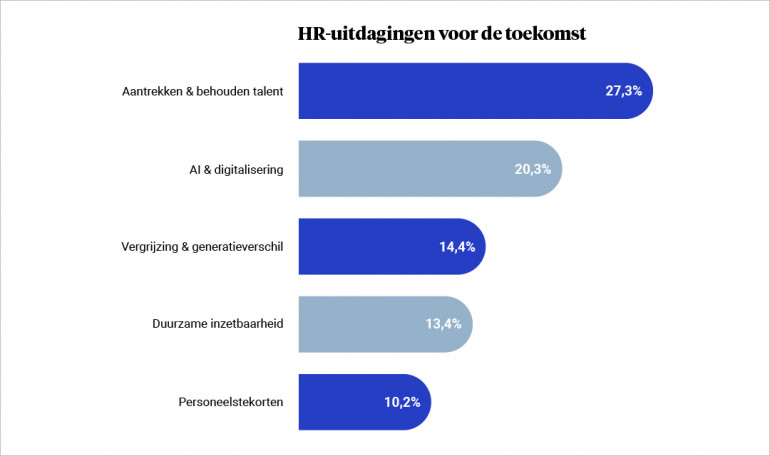
What are the biggest challenges for HR in the future?
HR priorities and challenges are clearly shifting from previous years. The survey shows that organizations are shifting their focus from recruiting to retention, employee feedback is becoming slightly more important and the reasons for employee turnover are changing.
- Attracting & retaining talent
- AI & digitalization
- Aging & generational difference
- Sustainable employability
- Personnel shortages
- Work pressure & mental well-being
1. Attract & retain talent
The biggest challenge for HR in 2026 is attracting and retaining talent. This is often mentioned in relation to labor market tightness and mobility of young talent.
From recruiting to retaining: a clear shift
Where in 2024 finding new employees was slightly more important (53.7 percent vs. 46.3 percent), in 2026 we see a reverse trend. Employee retention is now perceived as the greatest challenge (53.2 percent vs. 46.8 percent). This underscores the need for a strong employee journey, development opportunities and strategic workforce planning.
Employee feedback is gaining ground
Striking is that employee feedback is becoming slightly more important in strategic planning: from spot 4 to spot 3. Organizations are realizing that listening to employees is important to improve retention and job happiness.
Strategic workforce planning
Continuing labor shortages and an aging workforce make strategic workforce planning indispensable for organizations that want to stay future-proof. First, strategic planning helps prevent knowledge loss due to aging, allowing organizations to retain expertise and business-critical knowledge. Second, it provides advancement opportunities, which is relevant given that the lack thereof is the leading reason for employee turnover at 33.5 percent. Third, it increases flexibility in roles and employability of employees. And that, in turn, is especially important in a rapidly changing work environment.
Where in 2023-2024 organizations acted mostly reactively, in 2025-2026 we see a clear shift toward proactive planning. The survey shows that strategic workforce planning is rising in priority, both organizations and HR practitioners themselves feel, and is increasingly being linked to long-term goals such as knowledge retention, agility and sustainable employability.
Why is it so urgent now?
- Aging and outflow: in many sectors, the number of employees retiring is rising sharply. This leads to knowledge loss and increased pressure for succession.
- Labor market tightness: finding new employees remains difficult, so retaining and developing existing talent becomes crucial.
- Generational differences: organizations must respond to differing expectations of Generation Z and older generations, which calls for flexible career paths.
2. AI & digitalization
Digital topics are gaining ground, but are not at the top of the priorities. HR does see the importance of AI and digitalization, but in doing so they question how AI will change the work of employees, to what extent HR itself is still needed and how AI can become value-added rather than a threat. In many organizations, AI and digitalization are still in the early stages or are partially integrated.
The biggest obstacles cited by HR are: lack of skills and training among employees, keeping up with technological developments, technical implementation and integration with existing systems, and resistance or acceptance problems among employees.
HR also see a substantive task: preparing employees to work with AI, ensuring they have the right digital and soft skills (critical thinking, adaptability), and using AI to improve strategic decision-making and efficiency.
2. Aging & generational differences
Aging in the workplace seems to be more prevalent than a few years ago. There is much concern about knowledge retention, succession and an agile organization when older employees leave. Interestingly, organizations are now more likely to choose hiring young employees as a solution to staffing shortages versus promoting lifelong learning.
Although Generation Z was not explicitly asked as a theme in the survey, open-ended responses clearly show that organizations see the arrival of this new generation as a major concern. HR professionals mention the challenge of retaining young talent, especially because this group has different expectations of work: more need for development opportunities, agility, meaning and a culture that fits their values.
In addition, respondents indicate that the combination of aging and the rapid mobility of younger employees leads to additional pressure on knowledge transfer. The question "Who is going to teach the new generation the trade?" is frequently heard. This requires a more conscious approach to onboarding, mentoring and connecting generations in the workplace. Organizations that manage to build this bridge not only create continuity, but also a culture in which young and old learn from each other and remain future-proof together.
Read also: Play into aging with retirees: flexible, motivated and full of experience
4. Sustainable employability
HR sees sustainable employability as one of the most important themes on the HR agenda for 2026. Sustainable employability is also cited as a future challenge by 13.4 percent of HR as the most important issue. The challenges lie in the structural, long-term task: how to keep employees physically, mentally and in terms of skills employable in a rapidly changing labor market and organization.
Sustainable employability is linked to:
- retaining people in tight labor markets;
- preventing dropout due to workload, mental health and limited development opportunities;
- better matching individual needs (work-life balance, taxability, life stage) with what the organization can offer in roles, hours, tasks and career.
5. Staff shortages
In virtually all sectors, staff shortages remain a persistent challenge. HR professionals report that finding and retaining sufficiently qualified personnel is becoming increasingly complicated. The combination of a tight labor market, an aging population and a shortage of skilled workers is increasing the pressure on teams and making organizations more vulnerable to attrition and turnover.
This requires HR to have a clear vision, but also an organization that is agile enough to deal with this reality. It's not just about attracting new people, but rather about sustaining talent retention, strengthening professionalism and creating a work environment in which employees want to stay. Organizations that do this well stand out in a labor market where people have more choice than ever.
6. Work pressure & mental well-being
Work pressure and mental well-being are high on the agenda. HR professionals are increasingly concerned about rising absenteeism, employee mental toughness and maintaining a healthy organizational culture. Increasing mental resilience, psychological safety and sufficient recovery time are indispensable in this regard.
In many organizations, high workload is felt, which not only puts pressure on productivity, but also affects team dynamics and culture. Therefore, more and more organizations are investing in programs that support mental health, ranging from vitality programs to coaching to training executives in early detection and difficult conversations.
This shift shows that wellness is no longer seen as a "bonus," but as a necessary condition for keeping employees employable, engaged and healthy.
Hybrid working
Hybrid working and flexibility seems a bit less urgent for 2025 than for 2024, possibly because it is now more established and no longer seen as a top priority in most organizations.
"Everyone dreamed of it: working where and when it suits you. No more fussing about travel time, no more crooked looks when you don't show up at the office until 9:30. In sweatpants or dress pants, at home or at the office. Complete control over your day. Freedom at last. But what do we notice now, a few years later? And how do we make hybrid work?" You can read about it in the column by Noor Elshof.
Stay informed throughout the year
Do you want to stay abreast of important HR trends in 2026 and keep honing your HR strategy in the meantime? Then sign up for the Trends in HR newsletter and receive new inspiration in your mailbox every two weeks.